Stake Turkey: not a link, a guide that answers
Most people searching for Stake Turkey are looking for a link. There is no link here — there is what the pages promising one actually collect, why an account will not open, how many lira of staking a wagering requirement really means, and which step in a crypto cashier cannot be undone. All of it from the operator’s own terms and from arithmetic anyone can repeat.
What this site is
Stake Casino Türkiye is an independent guide. It is not Stake, it is not run by Stake and it has no connection to Stake; the brand name is used to identify the product being described.
No sign-in address is handed out here, no application file is hosted and no account is opened. Everything written here comes from the operator’s own terms and from arithmetic anyone can repeat.
Someone typing Stake Turkey into a search box usually wants one thing: an address. This page does not hand one over, and the reason is arithmetic rather than principle — look at what the pages promising that address actually do, and the price of the thing being asked for becomes visible.
What is here instead: why an account will not open, how a copied sign-in screen is recognised, how many lira of staking a bonus really means, which step in a crypto cashier cannot be undone, where a game’s RTP is written, and how a single round can be checked on your own. All of it from the operator’s own terms and from arithmetic anyone can repeat.
“Stake Turkey” is really two separate pieces of information
Two words, two questions, and they usually get mixed together.
Stake is a casino brand with a crypto cashier: deposits and withdrawals run through coins, and beside the big studios’ slots and live tables the lobby carries house-built originals — crash, mines, plinko, dice. Those house-built games are the only place where a round can be checked afterwards; how it is done is on games and RTP.
Turkey is not part of the brand; it is the side the search comes from — the questions someone asks in Turkish: signing in, is it trustworthy, the bonus, withdrawals, the app. This site answers the questions gathered under the Stake Turkey heading one by one, and replaces none of the answers with a link.
What Stake Turkey searches are really looking for
We pulled the demand for this subject from Google’s own keyword tool in September 2026, because a guide written without looking at what people ask is a guide written for its author. The table decided the shape of this site:
| What people type | Monthly searches |
|---|---|
| stake giriş (both spellings together) | ~220,000 |
| stake | ~60,500 |
| stake casino | 1,900 |
| stake tr | 720 |
| stake com türkiye | 480 |
| stake türkiye | 390 |
| stake türkiye giriş | 210 |
| stake bonus | 110 |
| stake güvenilir mi | 90 |
| stake para çekme | 30 |
One sentence comes out of that table: the overwhelming majority of Stake Turkey searches are looking for a door, not for an answer. And that is why pages selling the door exist.
The second sentence matters more: there is no door here. Every section below looks at the questions someone asks a week after finding the door — because that is where the money is actually lost.
A crypto casino alternative to Stake for players in Turkey
%150on your first deposit
from 20 USDTup to 120,000 USDT
- Wagering requirement x35
- No identity check up to 5,000 USDT in winnings
- The widest choice of providers and slots
What is actually in the Turkish search results
After building the table we did a second thing: opened the first ten results for the Stake Turkey query and counted what they carried. The result explains why this site is written the way it is.
The operator’s own page sits first. Almost all of the remaining nine were third-party sites with the brand name in the domain. Four of them, measured:
| Page | Words | Headings | What it does |
|---|---|---|---|
| The first | 102 | 1 | A copy of a lobby image, no text |
| The second | 1,371 | 16 | Headings for “login”, “cheats”, “winning hours” |
| The third | 778 | 13 | Another brand’s name left in the middle of the text |
| The fourth | 4,059 | 10 | A lobby copy: 45 images, two tables, a game guide |
The third row is the striking one: inside a page describing Stake, another betting brand’s name and headings were left standing, uncorrected. That is the clearest sign a text was generated and never read.
What they have in common is in the fourth column: none of them works out a wagering requirement, none says that a network choice cannot be undone, and none mentions a copied sign-in screen. The only thing they promise is an address — and handing over an address is far cheaper than writing the whole page.
That is the entire difference here: no address, arithmetic instead.
Signing in: six reasons an account will not open
The password, a changed two-step device, not remembering which email it was opened with, a pending identity check, a break you set yourself — and the sixth, that you are signing in to the wrong site.
The sixth is the expensive one. Copying a sign-in screen is free and takes five minutes; the copy looks too much like the original to be told apart. The moment you type your password into it the account is not yours, and on an account holding a crypto balance that is a transaction with no way back.
Pages promising a “current login link” do three jobs: insert their own advertisement into the path, publish the same text with the date changed every month, and copy the sign-in screen to harvest what is typed into it. For the third there is exactly one piece of advice here: type the address correctly once, bookmark it, and never arrive from a search result again. The habits of ruling causes out in order, and of never losing a password twice, are on signing in.
A sign-in screen asks for an email and a password. Any screen asking for a wallet recovery phrase, a full card number, a remote-access app or a code that arrived on your phone is fake, without exception.
The screen that shows the address is the real one
There is a measurable way to tell you are on the wrong site: the real address does not stay silent when someone arrives from a place it does not recognise. It opens its own window, states its decision and writes down the reason. That is precisely what copy pages do not do — their job is to let you in, because if they do not there is no password to collect.
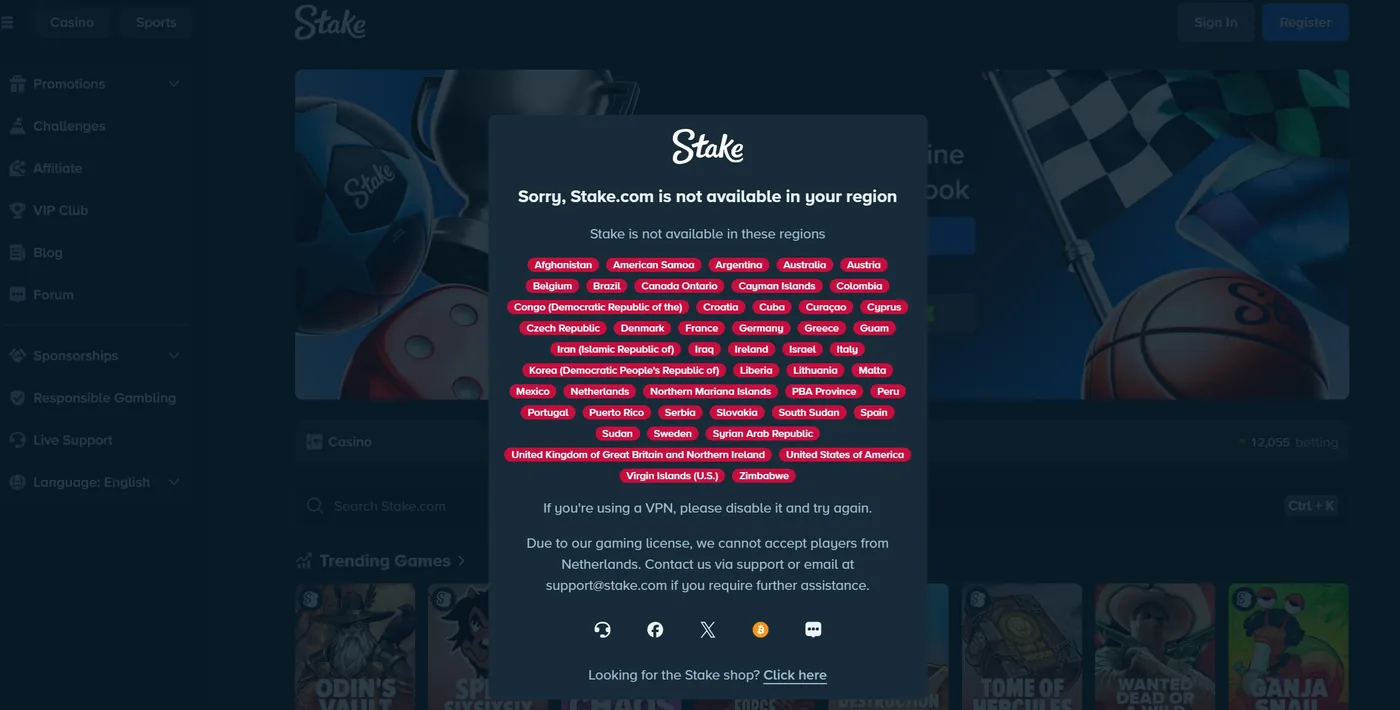
Three things are worth reading in the frame.
First, that the window opened on top of the lobby: the page loaded, the address works — what answered is the operator itself, not a connection error. Second, that the window hands over a support address and shows the operator’s own accounts; a copy page does not send its reader to the operator’s support desk. Third, the text itself: the decision is tied to a licence, described as an obligation rather than a preference.
Counting what this frame does not say matters even more. It is valid for about a day: lists like this change without notice, and yesterday’s frame is not evidence for tomorrow. It changes with where you look from: this frame was taken in the Netherlands, which is why the country named in the text is the Netherlands. And an account being able to open says nothing about money being able to leave it — those are two separate checks, and the second sits behind identity verification.
The cashier: the fast half and the step with no way back
The second cluster of Stake Turkey questions is money. A crypto cashier differs from a conventional one in three places: no card scheme stands in the middle refusing a transfer by category, speed runs both ways, and a sent transfer is final.
That third property creates the one irreversible step in this subject: sending over a network the operator does not credit. The transaction succeeds, the balance never appears, and there is no refund mechanism. The network line on the deposit page is read every single time — even if you have deposited to the same place before, because the list of supported networks changes.
Which currency the balance sits in is also a decision: a stable coin keeps it still, while a volatile one adds a currency bet you did not want on top of the game. The network fee, meanwhile, is a flat amount rather than a percentage — a ₺20 fee is nothing on ₺2,000 and ten per cent on ₺200. The whole of it is on what a crypto casino is.
From lira to a playing balance: four steps
This is the most concrete cashier-side question in Stake Turkey searches: how does the lira I hold turn into a balance I can play with? The answer is four steps, and only the last one happens at the casino.
One: an account at an exchange. Verification is detailed on this side and happens once. Identity, address and usually a selfie.
Two: depositing the lira. A bank transfer is almost always cheaper than a card; the difference is typically a percentage on the card and a small flat amount on the transfer.
Three: buying a stable coin. This is the right choice for a playing balance, because it separates the result of your session from a currency bet you did not intend to place. A balance sitting in a volatile coin can lose value without a single round being played.
Four: sending to the casino’s deposit address — over the network the casino names. The only step of the four that cannot be undone.
The most common mistake at step four is the network. The same stablecoin exists on several chains; a deposit page credits only some of them, and the supported list changes over time. Copy the address, read the network off the screen, and with an operator you do not know, send a small test amount first.
The second cost of this route is the network fee: a flat figure that does not grow with the amount deposited. A twenty-lira fee is negligible on a ₺2,000 transfer and ten per cent on a ₺200 one. The practical consequence is to top up less often and in larger amounts than the game’s bet size suggests — while deciding that amount before the cashier is opened.
The way out is not a mirror image of the way in: most operators require a withdrawal to follow the deposit route, and put their own approval in front of the transfer.
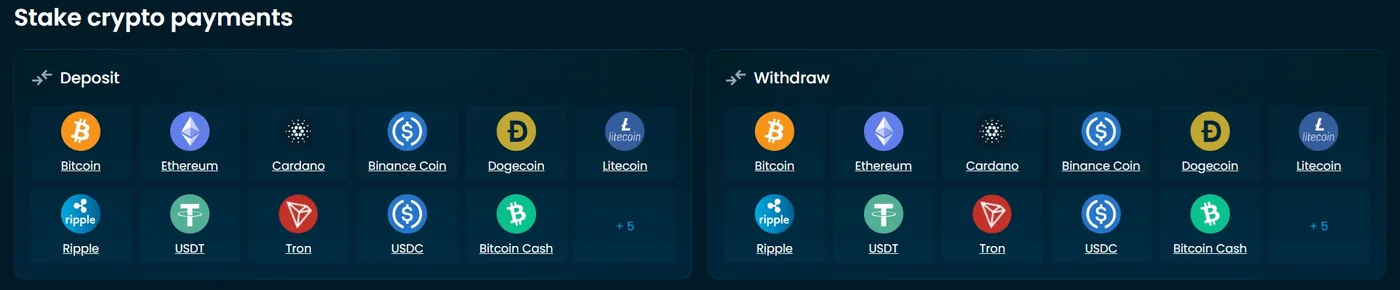
The two lists sitting side by side show the most misunderstood rule of the cashier in one glance: the way money came in decides the way it goes out. There is no option of depositing with one coin and withdrawing by some entirely different road; which currency the balance sits in is decided at the moment it arrives, and that decision still applies at the withdrawal.
There are two kinds of name in the list and they are not the same thing. The volatile ones — Bitcoin, Ethereum, Litecoin, Dogecoin and the like — put the balance into a currency bet independent of the game: it can fall or rise without a single round. The stable ones — USDT and USDC — keep the balance still and leave the result of a session to the game alone. For someone who thinks and plays in lira, the second group is the plain choice, because it adds no second bet.
The “+5” at the bottom right is a warning in itself: the list on screen is not the whole list. Which networks are credited is not written on this screen either — it is on the deposit page, and that is exactly why the fourth step cannot be undone.
If a withdrawal was refused, where to look, in order
This is the most common complaint in the subject and it is nearly always one of four causes. Knowing the order saves half an hour before writing to support:
- Is there an unresolved bonus on the account? If so, the whole balance is
locked. Either the requirement is completed or the bonus is cancelled; both are in the bonus terms.
- Is verification finished? A refused document means another full round
trip. Most refusals are a cropped corner or an expired date.
- Has the approval window passed? A fixed period you cannot influence.
- Did you exceed a ceiling? A daily or weekly limit turns a large amount
into instalments.
All four are in the terms and none is in the cashier — and all four can be read in five minutes before any money goes in.
A withdrawal is five steps, not one
“Fast withdrawal” marketing describes one of five steps and skips the other four:
- You request an amount.
- The casino checks whether a bonus blocks the route.
- If not, it verifies your identity.
- The request is approved, usually after a fixed period.
- The money is sent.
Only the fifth step has anything to do with the payment method. Crypto removes the banking day; it does not remove the processing time.
Four numbers govern the whole process and all four are in the terms before any deposit: the minimum withdrawal, the daily–weekly–monthly ceiling, the approval window in hours, and the moment identity verification is triggered. A weekly ceiling of ₺10,000 spreads a ₺100,000 win across ten weeks — information that is free today and expensive on the day it matters. How to find all four in five minutes is on deposits and withdrawals.
No payout time is published here. None of them was measured with a stopwatch, and a number nobody measured is a claim with decimal places.
Identity verification arrives at the worst moment
This is where players from Turkey are most often caught out: the identity check is usually triggered not by sign-up but by the first withdrawal. So the first withdrawal is a document check and a payment at the same time, which is why it is always the slowest.
Three documents recur: photo ID with all four corners visible, an address document no older than three months, and proof of the payment method. Most refusals are not suspicion — a cropped corner, an expired date, or a middle name that appears in only one of the three.
The practical shortcut: send the documents before requesting a withdrawal. An account that is already approved treats its first withdrawal like any other.
The bonus is a multiplication, not a percentage
A bonus is not extra balance; it is balance with a condition. The size of the condition is one multiplication:
| Bonus | Wagering requirement | Staked before a withdrawal |
|---|---|---|
| ₺500 | x30 | ₺15,000 |
| ₺1,000 | x35 | ₺35,000 |
| ₺2,000 | x40 | ₺80,000 |
| ₺1,000 bonus + ₺1,000 deposit | x35 on both | ₺70,000 |
The last row is the surprising one: if the requirement is calculated on bonus plus deposit, the multiplier never moves and the amount doubles.
The multiplier is only the first of five numbers. The maximum bet while wagering can void an entire bonus in one large round. The game contribution can turn a ₺35,000 requirement into ten times that. The time limit can put seven days on a requirement that takes thirty. The win cap decides the most a bonus can ever pay. All five are in the bonus terms and none is on the banner — bonus and wagering.
And the most practical clause: an active bonus locks the whole balance, not just the bonus part. It is the most common reason a withdrawal is refused — and the reason declining the offer in the cashier is an entirely sensible choice.
Games: the same studios, one difference
Part of the Stake Turkey searches go to games, and the answer there is short: large slot studios produce for every market, and the same title arrives with the same rules and the same published RTP. Live tables are broadcast from the same studios.
What is added on top is three things: more studios, crash games that end in seconds, and the casino’s own originals — mines, plinko, dice, hi-lo.
The only number worth knowing is RTP, and the only place it is written is the game’s own information screen: some studios ship the same slot in several versions with different RTPs, and the operator decides which goes into the lobby. RTP describes the game’s whole lifetime rather than an evening; two games with the same RTP can behave completely differently, and volatility makes the difference.
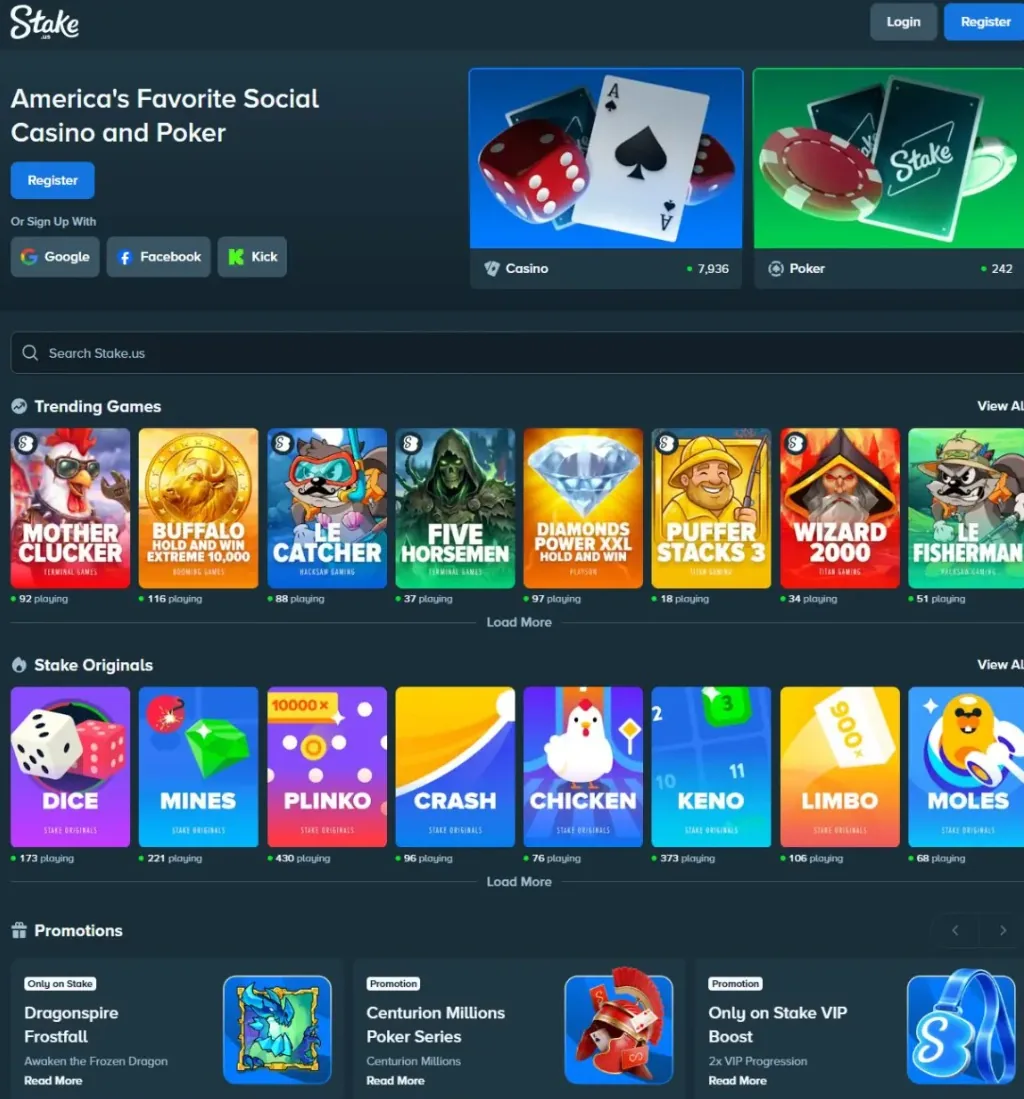
There are two rows in the frame and the difference between them is what this section is about. The upper row is studio games: found at other casinos under the same name, with the same rules and the same published RTP. The lower row is what the casino built itself: Dice, Mines, Plinko, Crash, Chicken, Keno, Limbo, Moles. The games in the second row are not found elsewhere under the same name, and that is the family whose rounds can be checked one by one.
The small number under each card — “173 playing”, “430 playing” — says how many people have that game open right now. It is a measure of popularity, not of chance: a crowded game gives nobody better odds, because rounds run independently of one another.
Where this frame comes from also matters: the brand’s separate US site, the social casino version, where the balance and sign-up arrangements are different. It is here because the game names are shared on both sides; it cannot be taken as a measure of cashier or bonus rules, which are written separately for each version.
Checking a round: two minutes, and almost nobody does it
In the originals family the operator publishes the fingerprint (hash) of a number before the round and reveals the number afterwards. You take the digest of the revealed number and compare it with the fingerprint published earlier; if they match, the result was fixed before you played and could not be changed afterwards.
That one property closes two doors at once: the operator cannot change a result after seeing the bets, and no tool claiming to know the result in advance can know it either — because all they can see is the fingerprint, and a number cannot be recovered from a hash.
What the check does not prove is equally clear: it does not make the game profitable. A provably fair round is a round drawn fairly from a distribution weighted in the house’s favour. The six-step procedure is on games and RTP.
App and APK searches
This is the largest search cluster in the subject, and one search box holds three different things: the operator’s own app, a repackaged file sitting on a download aggregator, and a wrapper that is nothing but a browser window pointed at the site. From outside the three cannot be told apart, because the signature that would tell them apart is the very thing that changed.
No installer is hosted here and none is linked. The grounds are not caution but impossibility: there is no way to tell you which of the three any given link is.
The browser is already enough: the round is computed on the operator’s servers, your phone draws a screen and sends two messages. Adding the site to the home screen gives you an icon with no installation, no permissions and no file of unknown origin. The app’s one real difference is promotional notifications — app and APK.
The measurable version of “is it trustworthy”
Five things can be checked from outside: the withdrawal ceiling, the approval window, the five numbers of a wagering requirement, the moment identity verification is triggered, and the round itself.
Three things cannot: payout speed, how the support desk actually behaves, and the company’s finances.
The answer to those three lives in a small experiment rather than in any text: deposit a small amount, play part of it, and withdraw the rest before depositing anything larger. That one exercise answers four of the five points from reality rather than from the terms, and answers them while no real money is at stake. The whole of it is on is Stake trustworthy.
Badges, “serving players since 20XX” lines and forum screenshots are not on that list. A badge is an image and is copied in four seconds; the age of a domain is read from whois, not from a sentence.
Twenty minutes, counted properly
Abstract percentages say nothing, so let us count. In a game that ends in seconds, at one unit a round, over twenty minutes, with rounds averaging ten seconds including the waiting:
- Rounds played: about 120.
- Total staked: about 120 units — six times a balance that felt like 20.
- Anywhere on screen showing that total: nowhere.
The expected loss is small; the number that surprises people is the total staked. Multiplying the speed of a round by the size of a bet is the most useful calculation on this page — and the reason the limits that work in a fast game are time and deposits rather than bet size. Three decisions and free support are on safer play; in Turkey, YEDAM’s appointment line is 115, free, and open to people calling about someone close to them.
The first week of a new account
Most Stake Turkey searches happen before an account is opened; yet every expensive surprise is decided in the first week after it is. Hence an ordered list:
Day one, before depositing. Turn on two-step verification and write the backup codes on paper. Set a deposit and loss limit in the account settings. Find the five numbers in the bonus terms. Read from the terms when identity verification is demanded.
Day one, the first deposit. A small amount, a stable coin, and the network line on the deposit page read. If it is the first time you are sending to a place you do not know, send a test amount first.
Day two. Send the verification documents without requesting a withdrawal. Photo ID with all four corners visible, an address document no older than three months, proof of the payment method. All at once, because each new document restarts the process.
Day three. Check a round yourself. Copy the hash, play a few rounds, rotate the seed, compare the digest. It is the one skill here that will be useful later, and it takes two minutes.
End of week one: the trial withdrawal. Take the rest out. That single operation answers the minimum withdrawal amount, the approval window, whether the documents really were approved, and whether the withdrawal has to follow the deposit route — all while no real money is at stake.
An account that does those five avoids most of the problems described on the rest of this site.
Ten short answers about Stake Turkey
| Question | Short answer |
|---|---|
| Where do you get the sign-in address? | From the operator’s own site, once, and into a bookmark |
| I typed my password into a copy page | Change it on the real site now, reset 2FA, write to support |
| Is an app required? | No; the browser does the same job, notifications are the only difference |
| Should I take the bonus? | Not if you are playing briefly or withdrawing soon |
| How much staking is a wagering requirement? | Amount times multiplier; double if it counts the deposit too |
| Why is my withdrawal waiting? | In order: bonus, documents, approval window, ceiling |
| Which coin? | The stable one, for a playing balance |
| The most expensive mistake? | The wrong network; there is no way back |
| Where is RTP written? | In the game’s own information screen, not in the lobby |
| I am playing to win back a loss | Stop, and call YEDAM on 115 |
Why there is no ranking or score here
It is a reasonable question, because most comparable pages open with a list. The answer fits into two points.
First, there is nothing for a score to rest on. Grading a casino needs two things: a withdrawal history and a complaint history. Neither is visible to this site from outside, and writing a number nobody measured with a decimal point produces a guess that looks like information. A guess is worse than no score at all.
Second, a ranking that is for sale is not a ranking. This site is paid through the buttons it carries and says so plainly on about. Publishing a top-ten list on the same site would make it a price list with stars drawn on it.
What is here instead is a checklist any reader can apply themselves — the withdrawal ceiling, the approval window, the five numbers of a wagering requirement, the moment verification is triggered, and the round itself. Applying it to a brand takes fifteen minutes and serves you better than any score we could hand out.
Five common mistakes
“A high round follows a run of low ones.” It does not. Rounds are drawn independently; the history strip has no memory.
“Cashing out early is safe.” It wins often, which is not the same thing. One loss at 1.10× wipes out eleven wins.
“Provably fair means you cannot lose unfairly.” It means the round was drawn honestly — from a distribution weighted in the house’s favour. Fair and profitable are different words.
“A bonus is free money.” It is balance with a condition, and the condition often also decides which cashouts count.
“A bigger maximum multiplier means a better game.” A ceiling you will never reach is marketing.
Four things that work when writing to support
When something goes wrong, the length of the exchange is decided by the first message. Four habits shorten it noticeably:
Ask one question. Three subjects in one message get an answer to the easiest of the three, and you start again for the other two.
Quote the rule’s own sentence. “The terms state this approval window and my request went in at this time” moves the conversation from an opinion to a document, where “why is my withdrawal waiting” does not.
Send the screenshot uncropped. Request number, date and amount in the same frame.
Share nothing that gives access to your account. Passwords, verification codes, wallet recovery phrases and remote-access apps are on that list. A real support desk does not ask for them; whoever does is not the support desk.
Three settings for playing on a phone
Most Stake Turkey traffic arrives from phones, and what is expensive on mobile is not the same as on a desktop:
Add the site to the home screen and stop using the search box. The one behaviour every copy page waits for is a search result being tapped at each sign-in. An icon on the home screen closes that possibility completely.
Keep notifications off. A promotional notification is the app’s only real difference from the browser — and one of the leading reasons a session runs longer than planned.
Turn on the session reminder. Time passes more invisibly on a phone than on a desktop, because there is no fixed reference on screen besides the clock. The reminder in the account settings turns all the arithmetic on this page into a single alert.
Volatility: the second number RTP does not mention
Two games can publish the same RTP and have evenings that look nothing alike. What makes the difference is volatility: how many large and small pieces that same average is divided into.
At low volatility, wins are frequent and small; the balance erodes slowly, the session lasts longer, and the largest win rarely exceeds thirty times the bet. At high volatility, hundreds of rounds give nothing and one round carries everything — the same 96% is hiding in there, just handed out far more rarely.
The practical consequence is a sentence about budget: in a high-volatility game, the number of rounds needed for the average to show itself is a multiple of what a low-volatility one needs. Someone playing ₺2 a round with ₺100 gets fifty rounds, which is not a number at which you can expect an outcome that appears once in five thousand. The same ₺100 at ₺0.20 a round is five hundred rounds. The game did not change; the length of the measurement did.
Under a wagering requirement the two pull in opposite directions. Low volatility turns the requirement over more predictably but rarely reaches a large surplus; high volatility is the only route that could finish the requirement before the maximum bet and the time limit get in the way, and most of the time it does not. Which is why, on a balance carrying a wagering requirement, game choice is arithmetic rather than taste — the detail is on bonus and wagering.
Volatility is written in most providers’ own game information, usually as three levels or a five-star scale. That single line beside the RTP says more about how an evening will go than the percentage next to it.
A short glossary
| Term | What it means here |
|---|---|
| Wagering requirement | How many times a bonus must be played through before it can be withdrawn |
| Game contribution | What percentage a type of game counts towards the requirement |
| Maximum bet | The per-round ceiling while a bonus is active; exceeding it can void the bonus |
| Approval window | The fixed period a withdrawal request waits before being processed |
| Withdrawal ceiling | The most that can be withdrawn daily, weekly or monthly |
| Network | The chain a crypto transfer is sent over; not all of them are credited |
| RTP | The average over the game’s whole lifetime, not over your session |
| Provably fair | Checking a single round against a fingerprint published in advance |
Five things this site does not claim
No payout times, because nobody measured them. No scores, because there is no ranking. No country list, because where an operator accepts players is written in their own terms and changes. No “we played here”, because nobody deposited from this desk. And no casino name beside the buttons, because the link is routed by region and a name would be wrong for most readers.
What it does claim is arithmetic anyone can repeat: the multiplication behind a wagering requirement, the share a network fee takes out of a small deposit, the speed of a round multiplied by the size of a bet, and why a hash cannot be run backwards. Who writes it and how it is funded is on about; corrections go to contact.
Where to go from here
If the account will not open: signing in. If you want to make the trust question measurable: is Stake trustworthy. If there is an offer on the table: bonus and wagering, then deposits and withdrawals. To understand the cashier itself: what a crypto casino is. For the maths of the games: games and RTP. If you came looking for a file: app and APK. If you are looking at a second brand: Roobet in Turkey. And if any of this is heading the wrong way: safer play.